Most people notice it gradually - a wider part, a thinner crown, more hair on the pillow than usual. Pattern hair loss rarely announces itself dramatically. It creeps in quietly, and by the time it becomes visible, the process has often been going on for months or even years. What drives it isn't stress alone, or diet, or even genetics in isolation. At the center of most cases is something far more specific: hormones.
How Hormones Influence Hair Growth
Hair doesn't just grow and fall - it cycles. Each strand goes through a growth phase (anagen), a transition phase (catagen), and a resting phase (telogen) before it sheds and a new strand begins. Hormones regulate how long each phase lasts. When certain hormones become imbalanced, they can shorten the growth phase significantly, producing thinner, weaker hair with each cycle until the follicle eventually stops responding at all.
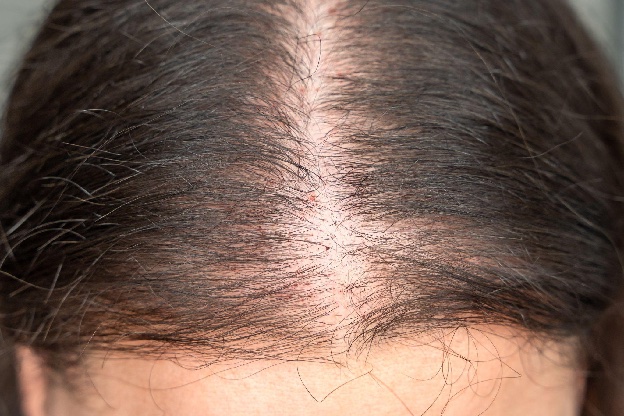
This isn't a random process. It follows a pattern - which is exactly why it's called pattern hair loss. The hairline recedes at the temples, the crown thins, or in women, the part gradually widens. The location and progression are largely dictated by hormone receptor activity in specific regions of the scalp.
The Role of DHT in Pattern Hair Loss
The hormone most directly responsible for pattern hair loss is DHT, short for dihydrotestosterone. It's a byproduct of testosterone, converted by an enzyme called 5-alpha reductase found in various tissues, including the scalp. DHT itself isn't harmful in most contexts - it plays a role in male development and other physiological functions. The problem begins when it binds to receptors in genetically sensitive hair follicles.
Once DHT attaches to these follicles, it triggers a process called miniaturization. The follicle shrinks over time, producing progressively thinner and shorter hair until it becomes barely visible or stops growing altogether. This is why people with high sensitivity to DHT experience hair loss even when their total testosterone levels are completely normal. The issue isn't how much DHT you have - it's how sensitive your follicles are to it.
Why Women Experience Pattern Hair Loss Too
Pattern hair loss is often framed as a male condition, but women are significantly affected as well - just through slightly different hormonal pathways. In women, estrogen plays a protective role for hair follicles. It helps maintain longer growth phases and counteracts the effects of androgens like DHT. When estrogen levels drop - during menopause, postpartum, or due to certain health conditions like polycystic ovary syndrome (PCOS) - androgens become relatively more dominant, and the same miniaturization process begins.
Women with PCOS, for instance, often experience elevated androgens alongside irregular cycles, and hair thinning at the crown or parting is one of the earliest visible signs. Unlike men, women rarely lose hair at the temples - the distribution is diffuse but still follows a hormonal logic.
Thyroid and Insulin: The Less-Discussed Hormonal Contributors
While DHT gets most of the attention, it isn't the only hormone that affects hair. Thyroid hormones - both too much and too little - can disrupt the hair cycle. Hypothyroidism, in particular, is known to cause widespread thinning by pushing more follicles into the resting phase at once. The hair often appears dull, dry, and slow to grow before the shedding becomes obvious.
Insulin resistance is another underappreciated factor. When the body struggles to regulate blood sugar, it tends to produce more insulin, which in turn can stimulate androgen production. This creates a hormonal environment that accelerates pattern hair loss - especially in people who already have a genetic sensitivity. This is one reason hair thinning is so commonly seen alongside PCOS, metabolic syndrome, and lifestyle-related weight changes.
If you're in the relentless hunt for the perfect mascara, that not only volumizes but also gives your lashes the much-needed lift, then you should absolutely give the dior show mascara a try. It's undeniably one of the best mascaras that guarantees both length and volume while leaving no clumps behind.
What This Means for Treatment
Understanding that pattern hair loss is hormonally driven changes how it should be approached. Treating only the surface - switching shampoos, applying oils, or taking generic supplements - rarely addresses the root cause. What the scalp shows is downstream of what's happening internally. Approaches that factor in DHT activity, hormone balance, and individual body chemistry tend to have more lasting results.
This is where brands like Traya have built their model - combining medical, nutritional, and scalp-level care based on individual hormone and health profiles rather than offering a one-size-fits-all solution. Using a DHT blocker tablet as part of a broader protocol, for example, makes far more sense than using it in isolation without understanding why DHT is elevated in the first place.
Final Thoughts
Pattern hair loss isn't simply about aging or bad luck. It's a hormonal process - one that's measurable, understandable, and in many cases, manageable when approached correctly. The first step is recognizing that what you see on your scalp is a signal, not just a cosmetic issue. Digging into the hormonal root cause is what separates temporary fixes from real, sustained improvement.
Keep exploring
Search AllWomenStalk for your next read.
Add allwomenstalk.com as a preferred source on Google to see more of our trusted coverage when you search.
Don't Miss the Latest Version
Get the latest stories, save favorites, and share with friends — all in one place.

New Earn badges & level up while you read
Create your profile. Earn badges. Level up your reading.
Join Allwomenstalk to track your streaks, collect badges, and earn XP for the things you already do—reading, sharing, and taking quizzes.
- 🔥Daily streaks with gentle boosts for 3, 7, and 30 days.
- 🏅Collect badges like Reader I–III, Socialite, and Quiz Ace.
- ⚡️Earn XP for reads, deep reads, likes, comments, and shares.
It’s free. Takes 30 seconds. Already have an account? Sign in.


Feedback Junction
Where Thoughts and Opinions Converge