There's a piece of jewelry that has survived disco, minimalism, the chunky gold revival of the early 2000s, and whatever we're calling the current quiet luxury thing. It sits flat on the wrist and catches light when you reach for a coffee cup. It costs anywhere between forty dollars and forty thousand. So what is a tennis bracelet, really, and why has it outlasted nearly every other jewelry trend of the last fifty years?
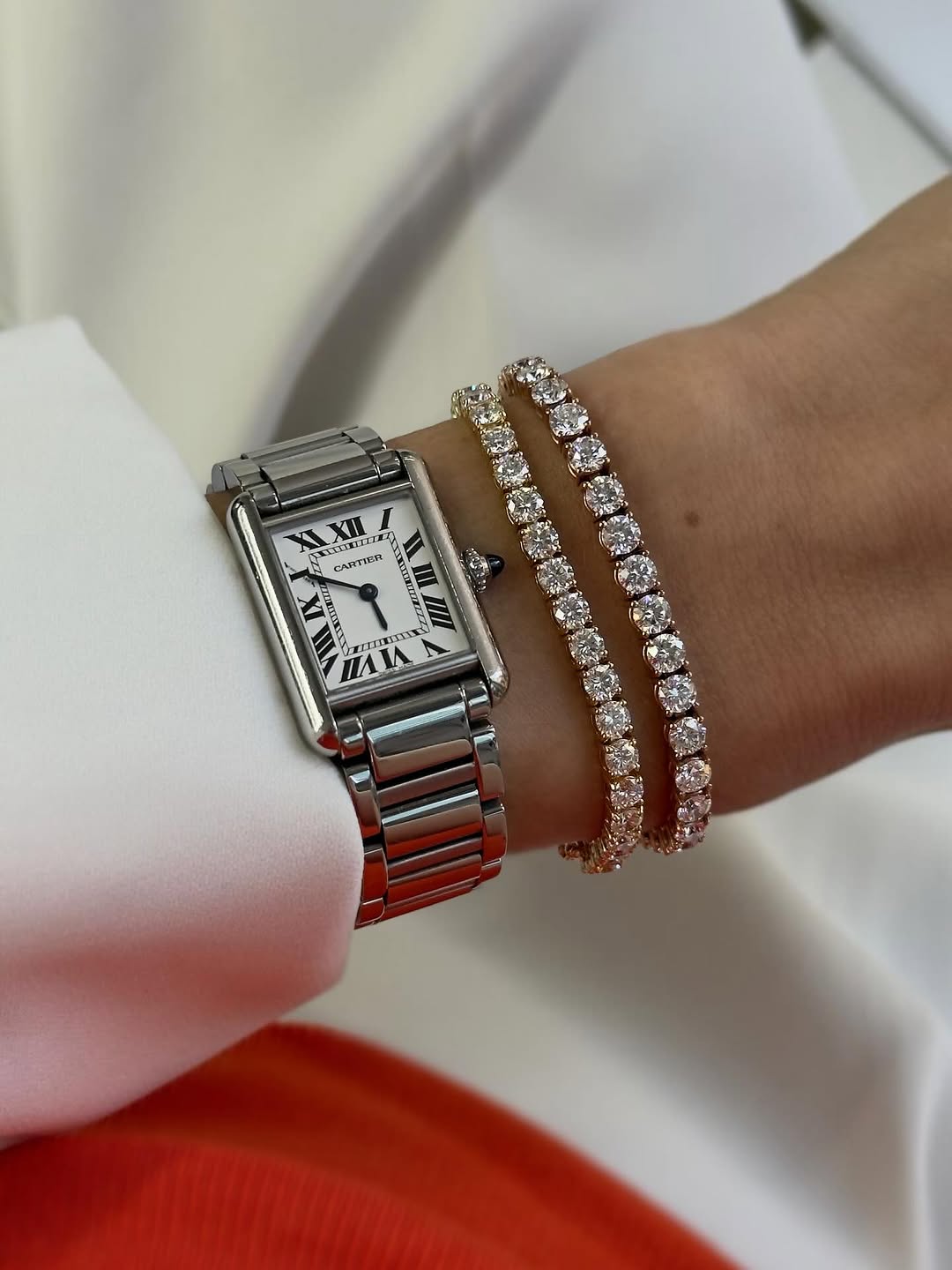
The short version: a flexible line of identically cut gemstones, almost always diamonds, set in a thin metal track that wraps continuously around the wrist. Each stone sits in its own setting (usually a four-prong or bezel), and the settings link together so the bracelet drapes rather than stays rigid. No centerpiece. No charm. Just a clean, uninterrupted line of stones.
The name has a good origin story, which helps.
The Chris Evert moment that gave it a name
In 1978, during the U.S. Open, Chris Evert was wearing a diamond line bracelet given to her by jeweler George Bedewi. The clasp broke mid-match. She asked the umpire to pause play so she could find it. Reporters started calling it her "tennis bracelet," and the name stuck. Before that, the same piece had been called an eternity bracelet or, more boringly, a diamond line bracelet.
The story gets repeated so often it has the texture of myth, but it's documented. What gets me about it isn't the broken clasp. It's that the bracelet was already popular enough in 1978 that a pro athlete wore one during a Grand Slam. The form predates the name by decades. Art Deco jewelers in the 1920s were making nearly identical pieces, often in platinum, often with calibre-cut sapphires between the diamonds. The midcentury versions were chunkier. Today's are thinner and more uniform, partly because cutting technology improved and partly because taste shifted toward restraint, though I'd argue the current ones have lost something the Deco pieces had. They're more correct and less interesting.
Thinking...
Please leave your email and we’ll get back to you on that.
Most tennis bracelets you see online look identical in a thumbnail. They are not identical in person.
The first thing I check is stone matching. In a quality piece, the diamonds get graded and selected so color and clarity stay consistent across the whole bracelet. A cheap one will have visible variation, one stone slightly yellower, another slightly cloudier. Once you notice it, you can't unsee it. Then setting precision, because the prongs should sit flush with each other and gaps between settings give away a rushed manufacturing process. Bezel-set versions are more forgiving here but lose some sparkle because less light enters the stone.
Clasps are the thing most people underweight, and Chris Evert's story is the permanent warning. A box clasp plus at least one figure-eight safety, sometimes two. If it feels flimsy when you open and close it in the store, assume it will eventually fail, probably while you're gesturing at dinner. The last test is flexibility. Pick the bracelet up by one end. It should drape like a chain, not arch like a stiff bangle. If it doesn't move, the links are too tight or the metalwork is poor.
A round tennis bracelet, meaning one made with round brilliant cut diamonds, is the default for a reason. The round brilliant has 57 or 58 facets and reflects the most light per carat of any standard cut. But emerald-cut and princess-cut versions exist and have their own appeal, particularly if you want something that reads more architectural than sparkly. My mother had an emerald-cut line bracelet she wore for thirty years and it looked nothing like jewelry, more like a small piece of hardware. I always preferred it to the round ones.
Thinking...
Please leave your email and we’ll get back to you on that.
Lab grown changed the math
For most of the bracelet's history, the price ceiling was set by mined diamonds. A 5-carat total weight tennis bracelet in decent quality ran ten to fifteen thousand dollars at retail in the early 2010s. That number has dropped substantially. A diamond tennis bracelet lab grown from a reputable maker now starts well under three thousand dollars for comparable carat weight and quality.
This is the entire economics of the category rewritten in about a decade.
Lab created tennis bracelets use diamonds that are chemically and optically identical to mined ones. The GIA grades them on the same scale. The difference is origin: one grew in the earth over a billion years, the other grew in a reactor over a few weeks. The philosophical question interests me more than the practical one, because practically, no one can tell them apart without specialized equipment.
What the price drop has done is move the tennis bracelet from "milestone purchase" to "reasonable gift." I have complicated feelings about that. Part of me thinks democratizing a luxury item is straightforwardly good. Part of me notices that the bracelet's cultural weight came from being a thing someone saved for, or got from someone who saved for it, and that weight is harder to manufacture when the price is normal.
Thinking...
Please leave your email and we’ll get back to you on that.
Colored stones, costume versions, and where the category gets fuzzy
A colored tennis bracelet swaps the diamonds for sapphires, rubies, emeralds, or in the more recent trend, a rainbow gradient of different stones. The rainbow ones I find genuinely charming when they're done well and embarrassing when they're not, and the line between the two is mostly about how carefully the stones are matched in saturation. Natural gemstone matching across a line is genuinely difficult and expensive. The good ones, you can spot from across a room. The bad ones look like a craft project.
Then there's the fake diamond tennis bracelet category, which is bigger than most people realize. Cubic zirconia versions sell at every price point between twenty dollars and several hundred. Moissanite versions, technically a different mineral with more fire than diamond, sit in the middle. I have no objection to any of these as long as they're sold honestly. The problem is when costume pieces get marketed with language designed to blur the line, which happens constantly and is most of what makes online jewelry shopping exhausting.
Designer tennis bracelets occupy the other end. A Nadri tennis bracelet leans into accessible fashion jewelry pricing with crystal or CZ stones in plated settings, which is a completely valid product for what it is. A tennis bracelet designer working at the fine jewelry level will build pieces with adjustable lengths, custom stone shapes, and clasps engineered like small machines. The price reflects the labor, not just the materials.
If you want to compare workmanship across makers, looking at a few elegant bracelet designs side by side will teach you more in twenty minutes than reading reviews for an hour. Pay attention to how the settings meet, how the safety clasp is engineered, and whether the carat weight is distributed evenly or concentrated in the front of the wrist (a cheat manufacturers use to make the bracelet look heavier in photos).
Thinking...
Please leave your email and we’ll get back to you on that.
Discover the mystique and charm of historical garments with our carefully curated inspiration from the medieval era. If you're seeking authenticity for a theme party or costume event, here are some truly renaissance outfit ideas that will transport you back in time. Evoke the spirit of grand festivities with fashion that celebrates tradition and craftsmanship. Embrace a different period, dress up and have fun!
How to actually wear one
The orthodoxy used to be that a tennis bracelet was a dressy piece, worn with cocktail attire, paired with diamond studs. That's been dead for a while. Now people wear them with t-shirts, stacked with a watch, layered with two or three thinner chains. The casual styling actually suits the piece better, in my opinion. It removes some of the formality that always made the bracelet feel a little stiff and bridal.
Sizing matters more than people realize. Too loose and it slides over your hand when you gesture, which is annoying and also how clasps eventually break. Too tight and it bunches up. A bracelet should sit about a finger's width loose at the wrist. Most makers offer half-inch increments. If you're between sizes, go shorter, not longer. I learned this the hard way after losing one in a restaurant booth in 2019, which I am still not entirely over.
Maintenance is minimal but not zero. Diamonds attract oil. After a few months of daily wear, the bracelet will look noticeably duller than it did out of the box. Warm water, a drop of dish soap, a soft toothbrush, two minutes. Once a year, take it to a jeweler to check the prongs and the clasp. Stones fall out of bracelets that haven't been inspected, always at the worst time.
Thinking...
Please leave your email and we’ll get back to you on that.
A piece worth the attention
The honest answer to why this bracelet keeps coming back is that the form is simple enough to absorb whatever the current decade wants from it. Wear it formal, wear it with a hoodie, wear it stacked with five others, it still works. The construction rewards quality in ways you can feel on your wrist. And lab grown stones have made the math interesting again, even if I'm not entirely sure how I feel about what that does to the meaning of the thing.
Feedback Junction
Where Thoughts and Opinions Converge
Keep exploring
Search AllWomenStalk for your next read.
Add allwomenstalk.com as a preferred source on Google to see more of our trusted coverage when you search.
Don't Miss the Latest Version
Get the latest stories, save favorites, and share with friends — all in one place.



Feedback Junction
Where Thoughts and Opinions Converge