Art TVs have always asked consumers to accept a trade-off.
The appeal is obvious: instead of leaving a large black rectangle on the wall, the screen becomes part of the room, displaying artwork, photography, or something more personal when no one is watching. But the category has often been evaluated first on aesthetics and only second on picture quality.
TCL’s A400U Designer TV is built on a different premise: an Art TV should still look and behave like art in the room, but that shouldn't lower the standard for what happens when the screen turns into a television.
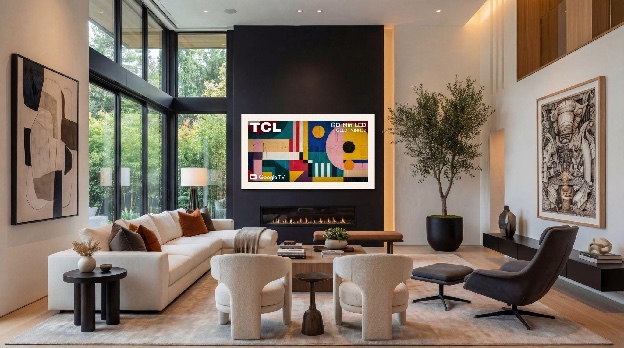
TCL’s new Designer Series strategy is centered on the idea that art should change with the way people actually live. Instead of treating the television as a static digital gallery, the A400U supports 270 combinations built around six art styles, five moods, and nine scenes, alongside 80 built-in works and more than 100,000 AI-generated images.
A traditional art library is organized around quantity: more works, more artists, more titles. TCL is pushing a more situational idea. The image on the wall can shift with the room, the mood, or the moment.
The included art experience is also positioned at zero subscription cost, including access to the 100,000-image AI library. That matters because an Art TV is not simply another content service. Its role is architectural as much as digital. If the product is supposed to remain visually useful even when no one is actively watching television, the art experience needs to feel like part of the product, not an optional layer added later.
The A400U Designer TV stands out in how it behaves when the artwork disappears.
TCL equips it with QD-Mini LED, Local Dimming Pro+, Halo Control System, a High Contrast HVA panel, and High Brightness Pro+ with up to 2,500 nits of peak brightness.
That is not separate from the Art TV proposition.
An Art TV lives in rooms that are often bright, open, and intentionally designed around natural light. Those are exactly the environments where a conventional screen can struggle with reflections, weak contrast, or a washed-out image. The A400U therefore pairs its high-brightness Mini LED architecture with a low-reflection screen, allowing the display to function more convincingly as both artwork and television in the same space.
During the day, the low-reflection treatment helps the artwork remain visually integrated into the room instead of turning the screen into a mirror.
At night, the QD-Mini LED system becomes more important. Local dimming gives the backlight finer control over bright and dark areas, while higher peak brightness gives HDR content more visual range. The result is a screen designed to transition from an ambient visual object to a serious entertainment display without requiring a different product philosophy for each role.
The native 144Hz refresh rate with Dolby Vision Gaming support extends that flexibility further. A living-room Art TV can spend the afternoon showing artwork, the evening streaming a film, and later become a gaming screen without either side of the experience feeling secondary.
Its real proposition is that the Art TV should no longer be treated as a design product that happens to play television. It can still serve as the room’s visual backdrop. It can still display changing artwork rather than dead screen space. It can still contribute to the home's aesthetic.
But when entertainment begins, the standard should rise with it. For TCL, that is the more meaningful direction for the category: art when the room needs art, and a genuinely premium picture when the room turns toward the screen.