You can love an unusual engagement ring and still want it to be easy to live with. Those wishes belong together. With so many striking designs to save, though, it is easy to focus on what looks different and overlook how it will feel on your hand.
“Non-traditional” covers a lot: colored gemstones, patterned stones, unexpected shapes, and bands that curve or branch. The useful question is which detail you actually want, and what it changes about wearing the ring.
Name the detail you keep coming back to
Look at a few saved designs and work out what they share. It might be a green stone, an elongated shape, or a band that resembles a vine. If you can name the attraction, you can keep it while changing other features to suit your routine.
For example, loving a nature-inspired ring does not mean you need a tall setting and an elaborate band. A patterned stone in a simpler setting may give you the same feeling with less going on around it. Likewise, a familiar gemstone can feel quite different when it is set sideways.
This also makes shopping with a partner easier. “I like the green patterns, but I want a quieter band” is much more helpful than “I want something unique.” It leaves space to compare real choices.
If you love moss agate, look closely at the pattern
A moss agate engagement ring draws attention in a different way from a sparkling clear stone. Its interest is in the pattern: areas of green, translucency, and uneven detail that can make the stone feel like a small landscape.
When looking through Molleln’s moss agate engagement ring collection, notice whether you prefer a dense green pattern or a more open, translucent appearance. Molleln identifies its moss agates as natural, so ask how much the supplied stone may vary from the catalog photograph.
If that pattern is the reason you love the ring, ask whether you can see the particular stone before ordering. A representative photo can explain the design without showing exactly what your finished ring will look like.
The pattern is only part of the choice. Moss agate is less scratch-resistant than ruby or sapphire, so ask the jeweler about edge protection and what careful daily wear means for that design. If you regularly garden, lift weights, or handle cleaning products, plan when you will take the ring off and where you will put it. A setting can protect parts of the stone, but it cannot remove its care needs.
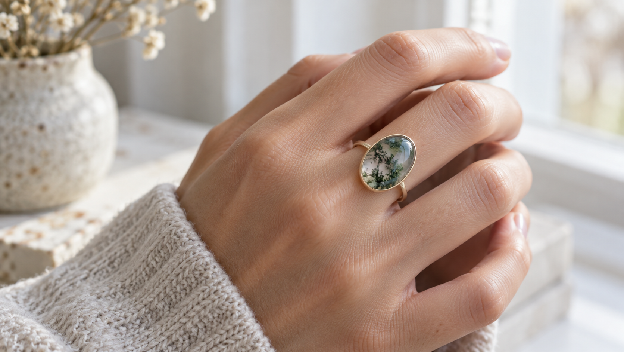
Look at the side view before choosing
The top photograph tells you about the style. The side photograph helps you understand the structure. A ring with a modest-looking stone may still sit high above the finger, while a broader design may have a lower profile.
Think about the moments when rings get in the way: pulling on a sweater, wearing gloves, or reaching into a pocket. Ask about the setting height and whether there are projecting points or details. You do not have to reject every raised design, but you should know what you are choosing.
Try on something with similar proportions if you can. It does not need to be the same gemstone. You are checking how much space the ring takes up and whether the band feels comfortable between your fingers.
Bring the wedding band into the decision
An unusual outline or a low center setting may keep a straight wedding band from sitting close to the engagement ring. You might like the gap. If you prefer the rings to fit closely, a curved or shaped band may work better. That is easier to explore before buying than to solve months later.
Browsing coordinated bridal ring sets can show how two rings are designed to sit together. Check their combined width and height, not just how neatly they fit in the picture. A pair can look beautifully balanced and still feel like more jewelry than you want to wear every day.
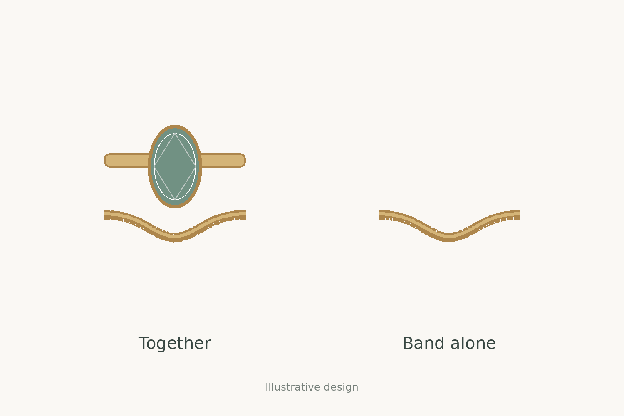
Also decide whether you will wear the wedding band alone sometimes. A dramatic contour that frames the engagement ring may feel quite different on its own. Ask to see both arrangements.
Let personal taste be enough
The ring does not need an elaborate explanation. Liking its color, its pattern, or the way it sits beside your other jewelry is a good place to start.
Once the practical questions are answered, return to the detail that first caught your attention. Is it still the one you keep noticing? If the answer is yes, and you are comfortable with the care and fit, the unusual choice may also be the choice that feels most natural to you.